

31/10/2025


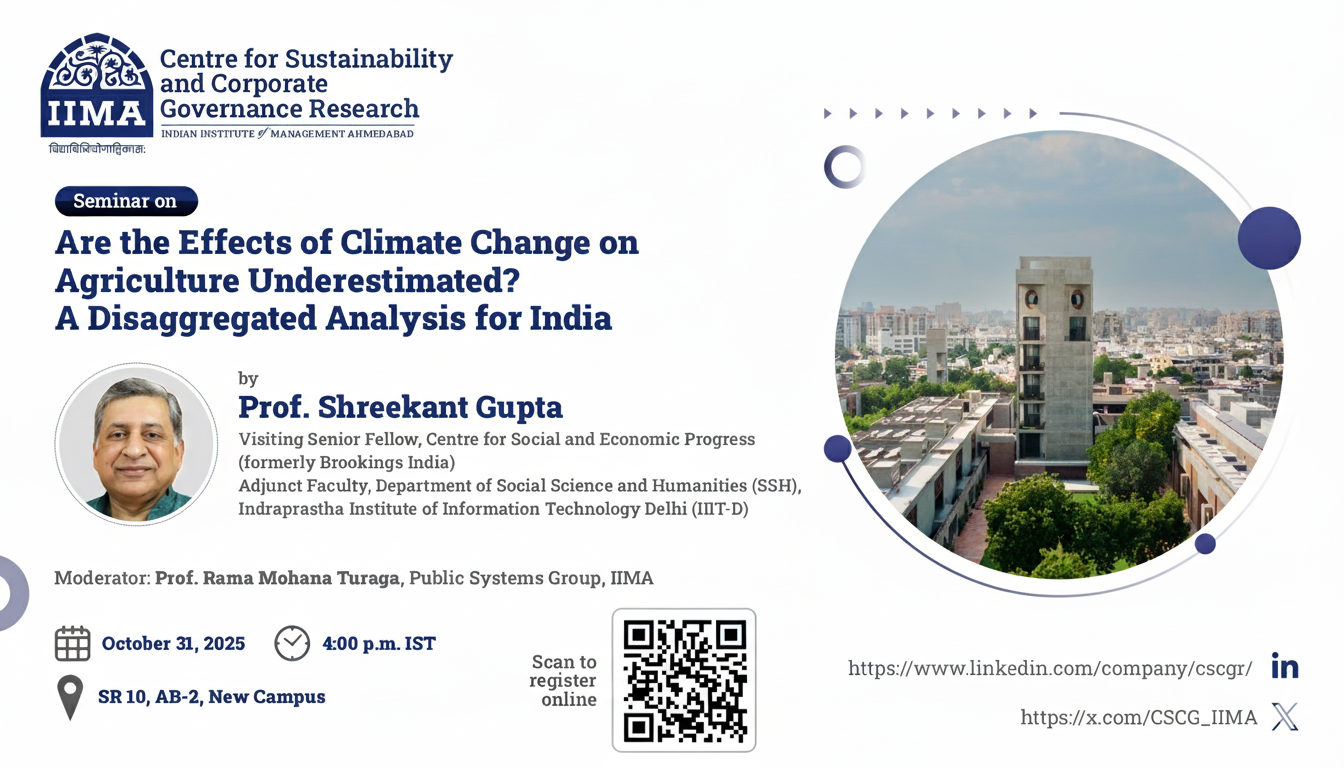
Abstract:
An extensive and growing body of literature on the consequences of climate change for agriculture provides a wide range of estimated effects. We argue the effects are underestimated due to (i) use of static specifications (ii) neglect or inadequate treatment of intra-year variability in climate (rainfall and temperature) shocks, and (iii) the asymmetric impact of positive and negative climate shocks. We illustrate this underestimation by focusing on the Indian agricultural sector. Through addressing these sources of underestimation, we show large long-run impacts of rainfall and temperature shocks on yields for a wide range of food and non-food crops. For instance, the impacts are 36 to 66 per cent higher in the long run for key crops such as rice, wheat, cotton and sugarcane. This calls for significant adaptation measures to climate-proof agriculture from future climate change.
Speaker Bio:
Prof. Shreekant Gupta is an economist with over 30 years of policy and academic experience in environmental and urban issues, including climate change. Currently, he is a visiting Senior Fellow, Centre for Social and Economic Progress; Visiting Professor, Indian School of Public Policy, Adjunct Faculty, IIIT Delhi and Executive Education Senior Fellow, LKY School of Public Policy, National University of Singapore. His previous positions include Professor, Delhi School of Economics, University of Delhi; Director, National Institute of Urban Affairs and Associate Professor, National University of Singapore. He has also worked as an economist in the Environment Department of the World Bank at Washington DC. Professor Gupta was an author of the 5th and 6th Assessment Reports of IPCC and serves as an editor of Climatic Change (Springer). He has a PhD in Economics from the University of Maryland and a Masters from the Delhi School of Economics. He was Fulbright Fellow at the Massachusetts Institute of Technology (MIT) and Shastri Fellow at Queens University, Canada.
To know more about the speaker, go through the links given below:
Google Scholar
LinkedIn


