Business Inflation Expectations Survey (BIES) – January 2026

Business Inflation Expectations Survey (BIES) – January 2026

A. Inflation expectations

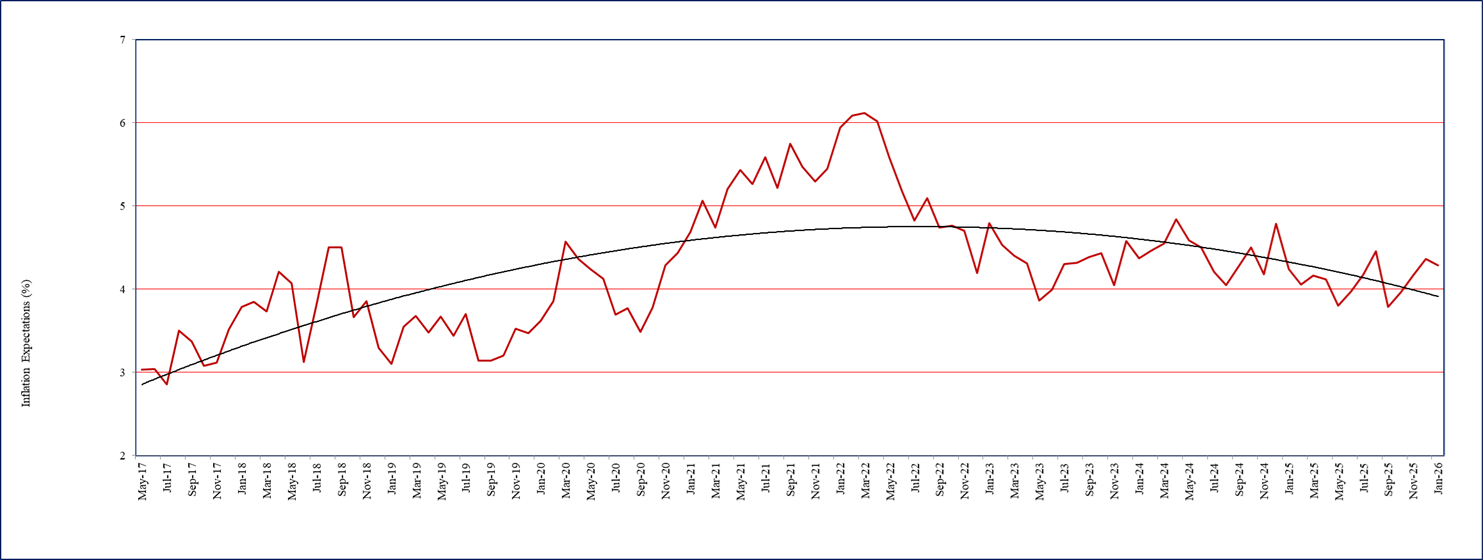
  • One year ahead business inflation expectation in January 2026, as estimated from the mean of individual probability distribution of unit cost increase, has declined marginally by 7 bps to 4.29%, from 4.36% in December 2025. Firms’ average inflation expectation during the past 12 months has remained anchored around 4.11%. The trajectory of one year ahead business inflation expectations is presented in Chart 1.
     
  • The uncertainty of business inflation expectations in January 2026, as captured by the square root of the average variance of the individual probability distribution of unit cost increase, has increased significantly to 2.11% from 1.84% reported in December 2025.

                                                                                     Chart 1: One year ahead business inflation expectations (%) 
1


B. Costs

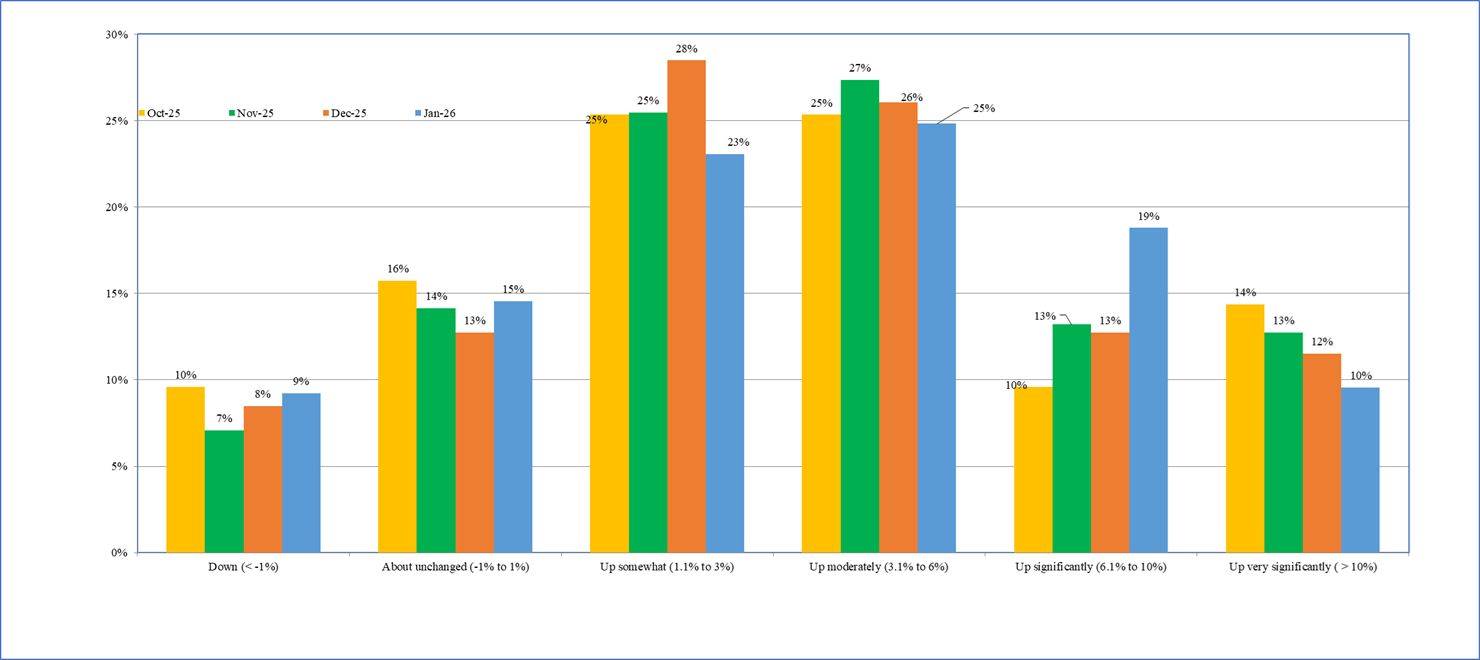
  • Overall, the cost perceptions data in January 2026 indicate moderate increase in cost pressures.

1The Business Inflation Expectations Survey (BIES) provides ways to examine the amount of slack in the economy by polling a panel of business leaders about their inflation expectations in the short and medium term. This monthly survey asks questions about year-ahead cost expectations and the factors influencing price changes, such as profit, sales levels, etc. The survey is unique in that it goes straight to businesses - the price setters - rather than to consumers or households, to understand their expectations of the price level changes. One major advantage of BIES is that one can get a probabilistic assessment of inflation expectations and thus get a measure of uncertainty. It also provides an indirect assessment of overall demand condition of the economy. Results of this Survey are, therefore, useful in understanding the inflation expectations of businesses and complement other macro data required for policy making. With this objective, the BIES is conducted monthly at the Misra Centre for Financial Markets and Economy, IIMA. A copy of the questionnaire is annexed.

Companies are selected primarily from the manufacturing sector. Starting in May 2017, the “BIES – January 2026” is the 105 th round of the Survey. These results are based on the responses of around 1100 companies.

  • The percentage of firms perceiving costs ‘up somewhat’ (1.1% to 3%) in January 2026 has declined to 23%, from 28% reported in December 2025 survey (Chart 2). At the same time, the percentage of firms perceiving costs ‘up significantly’ (6.1% to 10%) in January 2026 has increased to 19%, from 13% reported in December 2025.

                                                        Chart 2: How do current costs per unit compare with this time last year? – % responses
2


C. Sales Levels

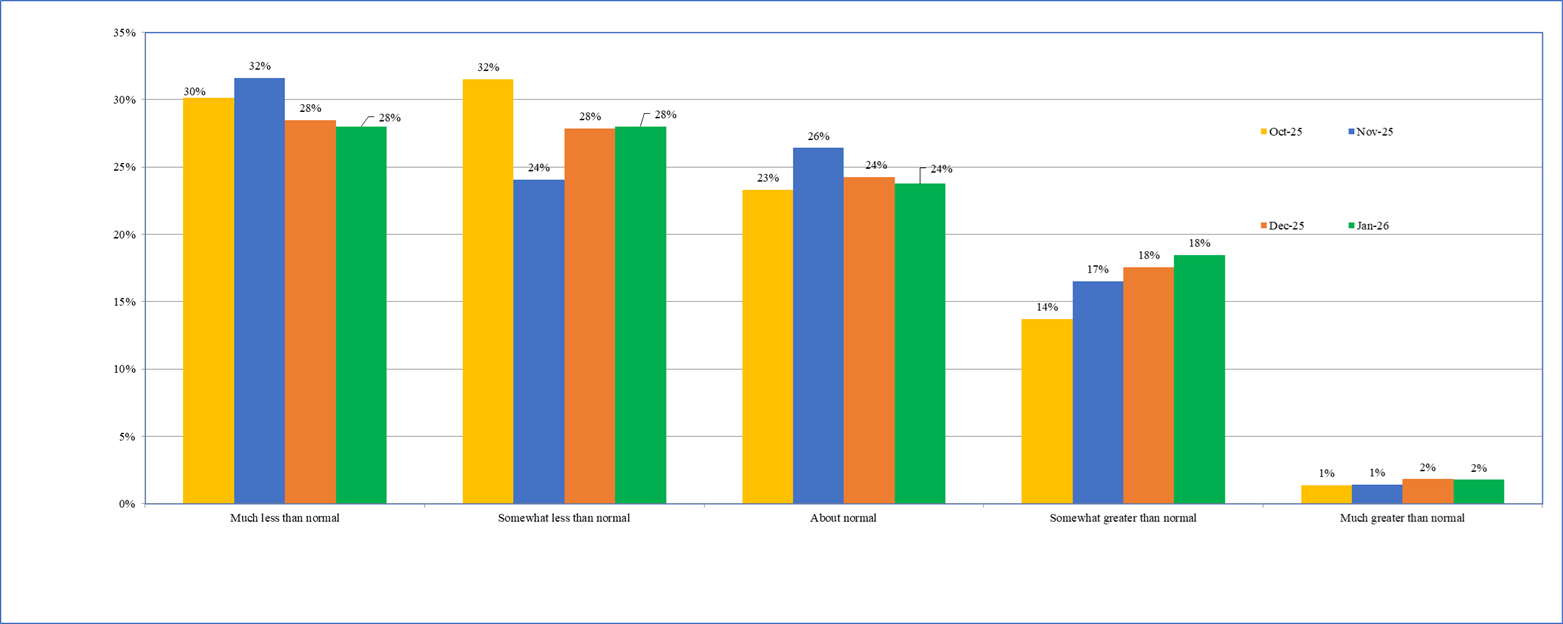
  • Firms’ sales expectations remain subdued and similar during November 2025 – January 2026.
  • Around 56% firms in January 2026 are reporting ‘much less than normal’ or ‘somewhat less than normal’ sales 2 - same as reported in December 2025 (Chart 3).


                                                                                                  Chart 3: Sales Levels - % response

3


2"Normal" means as compared to the average level obtained in the preceding 3 years, excluding the Covid-19 period.

D. Profit Margins

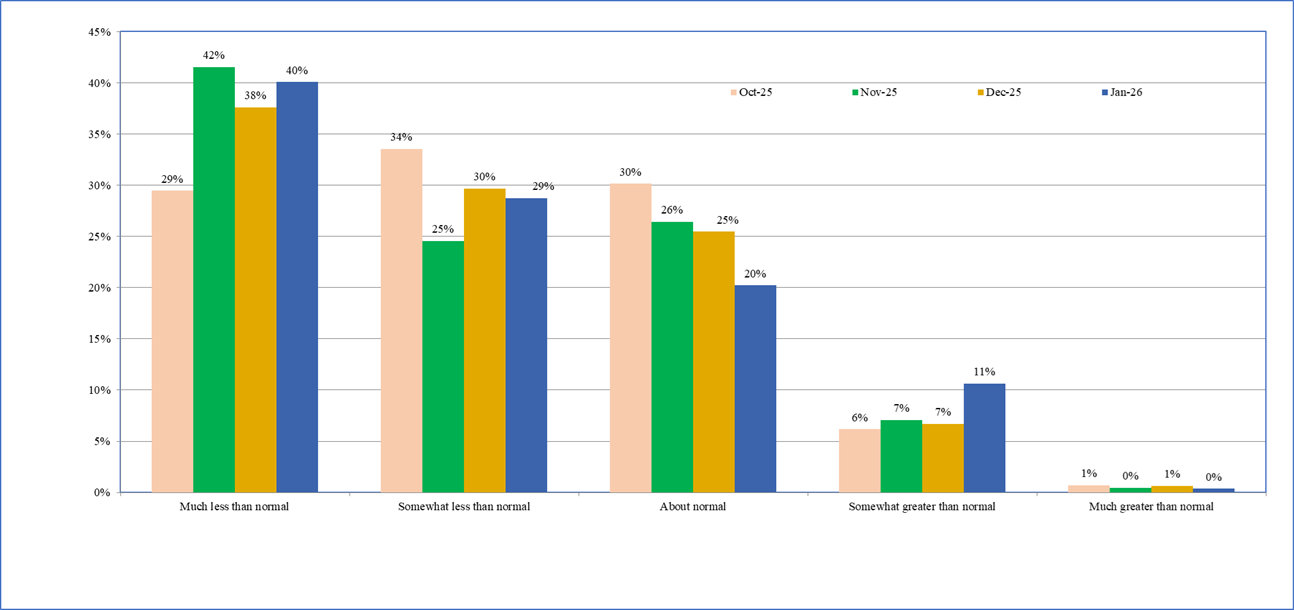
  • The percentage of firms reporting ‘somewhat less than normal’ or below profit margin expectations has remained high around 69% during November 2025 -January 2026 (Chart 4).
  • Overall, the profit margin expectations remain muted.

                                                                                                Chart 4: Profit Margins - % response

4


Business Inflation Expectation Survey (BIES) – Questionnaire

A. Current Business Conditions

Q1. How do your current PROFIT MARGINS@ compare with "normal" * times?
       o  Much less than normal
       o  Somewhat less than normal
       o  About normal
       o  Somewhat greater than normal
       o  Much greater than normal

Q2. How do your current sales levels compare with SALES LEVELS@ during what you consider to be "normal"* times?
      o  Much less than normal
      o  Somewhat less than normal
      o  About normal
      o  somewhat greater than normal
      o  Much greater than normal

@ of the main or most important product in terms of sales.
*"normal" means the average level obtained during the corresponding time point of preceding 3 years, excluding the Covid-19 period.

B. Current Costs Per Unit^
Q3. Looking back, how do your current COSTS PER UNIT compare with this time last year? 
      o   Down (< -1%)
      o   About unchanged (-1% to 1%)
      o   Up somewhat (1.1% to 3%)
      o   Up moderately (3.1% to 6%)
      o   Up significantly (6.1% to 10%)
      o   Up very significantly (> 10%)

'  of the main or most important product in terms of sales.

C. Forward Looking Costs Per Unit$
Q4. Projecting ahead, to the best of your ability, please assign a percent likelihood (probability) to the following changes to costs per unit$ over the next 12 months.

      o Unit costs down (less than -1%)
      o Unit costs about unchanged (-1% to 1%)
      o Unit costs up somewhat (1.1% to 3%)
      o Unit costs up moderately (3.1% to 6%)
      o Unit costs up significantly (6.1% to 10%)
      o Unit costs up very significantly (> 10%)

$ of the main or most important product in terms of sales.
Values should add up to 100%.

IIMA