~ The theme for the three-day mega event with 12 diverse tracks, scheduled from December 5-7, 2025, is “The Future of the Economy: People, Organisations, and Policy”.
~ IMRC 2025 witnesses participation from over 850 researchers, scholars, academicians, and leading management institutions.
~ The conference convenes leading scholars, early-career researchers, and practitioners for the dynamic exchange of ideas on various management research topics.
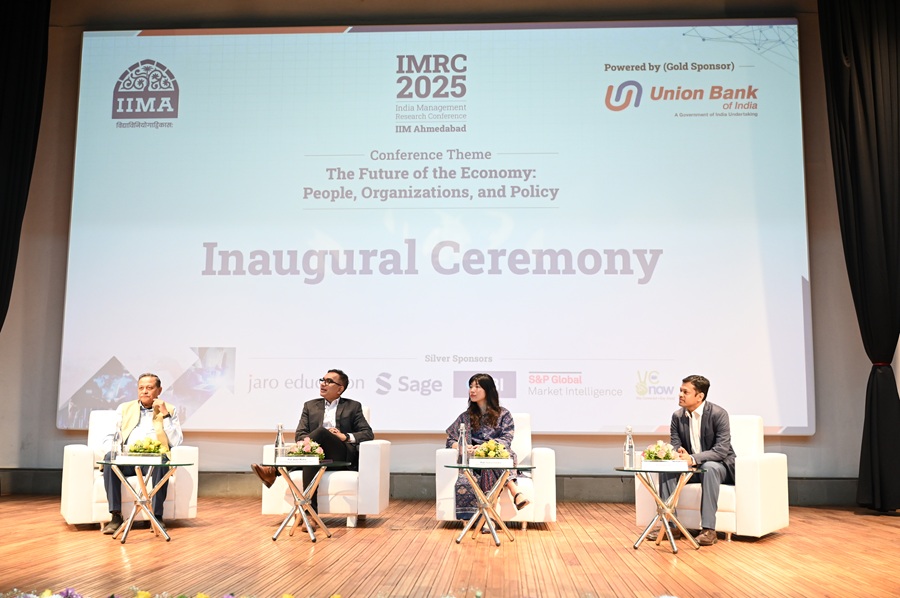
December 06, 2025: The Indian Institute of Management Ahmedabad (IIMA) inaugurated the second edition of the India Management Research Conference (IMRC 2025) at its campus on December 6. The three-day conference, scheduled from December 5-7, is centred on the theme “The Future of the Economy: People, Organisations, and Policy”, bringing together a vibrant community of researchers, scholars, and academics from across the world to engage in high- quality dialogue on emerging themes in management research.
Following a vibrant welcome and idea exchanges on day one, the formal inauguration ceremony of the conference was held on December 06, 2025, which was graced by Professor Anant Mishra, Director of Research and Professor of Supply Chain, VinUniversity, Hanoi; Professor Leona Chandra Kruse, Professor of Information Systems, University of Agder, Norway; Professor Bharat Bhasker, Director, IIMA; Professor Debjit Roy, Conference Convener; along with esteemed faculty members of IIMA and distinguished guests and participants.
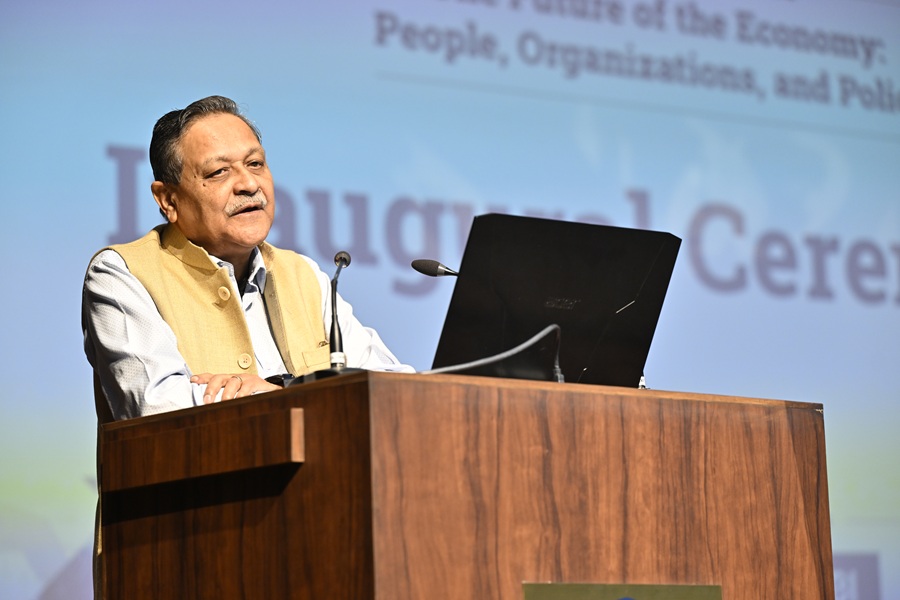
In his inaugural address, Professor Bharat Bhasker, Director, IIMA, shared a detailed perspective of India’s economic undercurrents in various sectors and management research ambitions. He said, “As the country aspires to be a global economy and a developed nation, we need to innovate solutions to our challenges at the leading edge of work, which also largely depends on research output in the country. Statistically, India has put behind all European countries to now rank third globally, only behind China and the USA, in published research output. But, in order to become a fully developed nation/Viksit Bharat, all aspects of our economy need a surge at full thrust. To realise this, we need quality research in all domains, such as agriculture, manufacturing, MSMEs, logistics and supply chains, AI, and semiconductors, etc., so that India can move up in the value chain.
He also added that the government is also stepping up its efforts to strengthen the country’s research ecosystem. “Recently, in November 2025, the government has launched the Research, Development, and Innovation Fund worth Rs. 1.4 lakh crores. Out of this, Rs. 40,000 crores will be channelled through the Anusandhan National Research Foundation. This will help to greatly boost the research in the country in various domains. This conference is our effort to bring together researchers from diverse domains to deliberate on various management techniques, encourage collaboration to bridge the gaps, so that the overall research can grow to boost the Indian economy.”
Professor Debjit Roy, Conference Convener, IIMA, welcomed all the scholars and participants and gave a brief overview of IMRC 2025. He said, “IMRC, which was born out of the vision to contribute meaningfully towards India’s growth story through management education and capacity building, has become a highly sought-after annual event. The second edition of IMRC is focused on the future of the economy and people, organisations, and policies, which are all inter-linked and have to be thought together. Through insightful debates and discussions, this conference will try to address many management questions of the current fast-evolving times.” Prof. Roy also touched upon the five versions of industrial revolutions that made a shift in human civilisation and how the time gap between the recent two revolutions has reduced significantly, referring to the acceleration from digitisation to people-centric automation and AI.
He also outlined the scale of IMRC 2025, which has attracted participation from over 850 researchers, scholars, and academicians, as well as leading management institutions. It featured nine conference-wide events and 142 track-level events. This year, IMRC received around 1400 abstract submissions from 30 countries, conducted 479 research paper presentations, and around 290 doctoral students/early career researchers are attending the conference, promising it to be a vibrant three-day exchange and collaboration event.
The ceremony was followed by two compelling keynote addresses by Professor Anant Mishra and Professor Leona Chandra Kruse, who shared significant insights from their research work and explained why the conference theme, “The Future of the Economy: People, Organisations and Policy”, is relevant in today’s times.
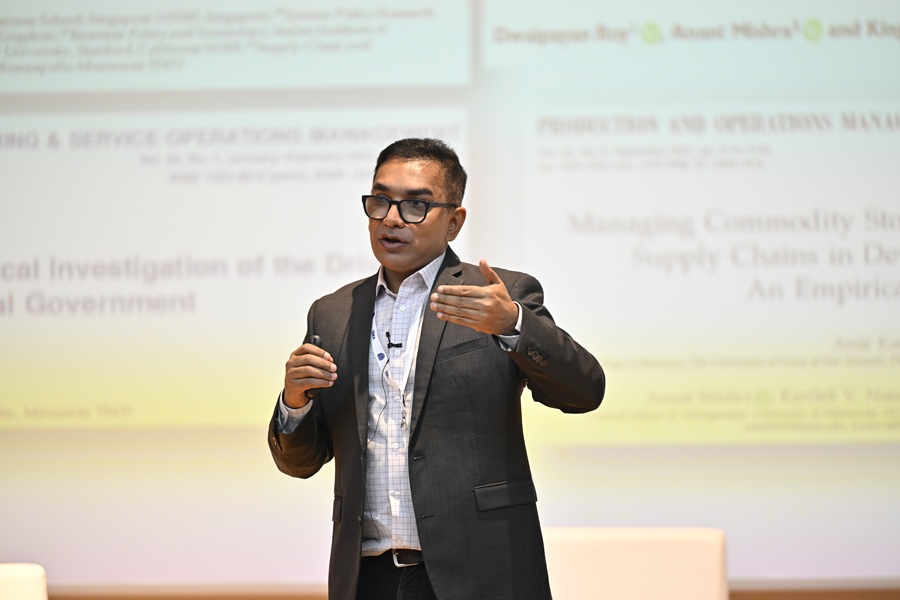
In his keynote address titled “Lessons from the Last Mile: People, Organisations, and Policy in Public Health Supply Chains”, Professor Anant Mishra, Director of Research and Professor of Supply Chain, VinUniversity, Hanoi, spoke about two of his studies in the public health supply chain domain in Senegal and Tanzania and highlighted the paradox of progress in emerging economies. He said that on one hand, the emerging economies are going through a great time in terms of focus on AI, semiconductors, and emphasis on manufacturing, yet at the same time, they have some nagging base-of-the-pyramid problems, such as the problem of essential medicines stockout. Explaining this, Prof. Mishra said, “Our focus on critical areas like AI and semiconductor investments showcases how countries can emerge as key players in the global supply chain. However, alongside this progress, we must confront persistent issues, such as the accessibility of essential medicines. It is essential that we harness the collaborative power of people, organisations, and policy to bridge the gap between innovation and implementation. Only through effective public-private partnerships can we overcome barriers and ensure that healthcare reaches every individual, particularly those at the base of the economic pyramid, to create a healthier, more equitable future.”
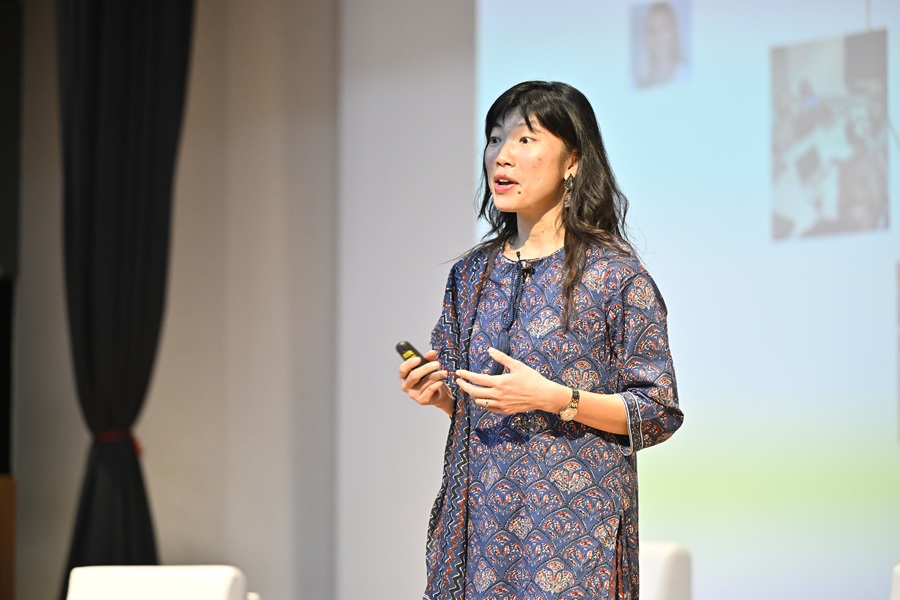
Professor Leona Chandra Kruse, Professor of Information Systems, University of Agder, Norway, delivered the second keynote address titled “Science for What Comes Next: Design as a Mode of Inquiry”. She talked about how we can leverage design to promote human flourishing and to find solutions to various problems. She said, “My research group focuses on how design can shape our interactions and improve real-world problems, including education. As we innovate, we must see design as a search process from problem to arrive at a solution; solutions that prioritise human needs—offering support, pleasure, and security. By leveraging thoughtful inquiry and design, we can create actionable knowledge that transforms organisations and drives change. We stand at the forefront of a new era and explore emerging technologies, where design is not just a process but a vital model for impactful research. Together, we need to design better futures.”
IMRC 2025 serves as a platform dedicated to shaping the future of India-centric management research. The conference convenes leading scholars, early-career researchers, and practitioners to explore management research problems, examine cutting-edge solutions, and explore the evolving management landscape. IMRC 2025 features 12 research tracks hosted by IIMA’s Centres of Research Excellence and disciplinary areas. These include:
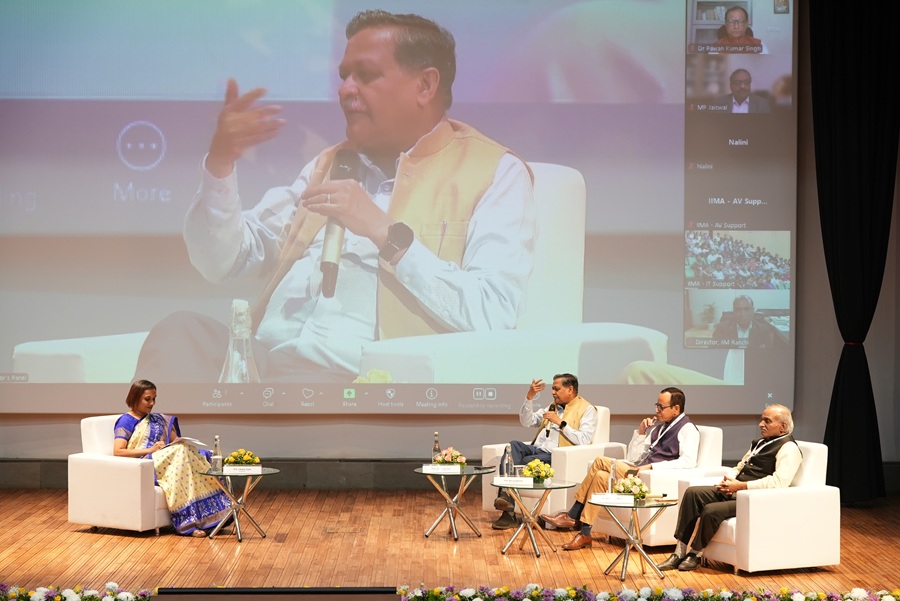
The conference also featured key thought-provoking sessions, including an Editor’s Panel on “Publishing in the AOM Journals”, wherein scholars and editors from leading international research journals shared insights on the publication process and emerging research directions. Another significant session on the second day of IMRC 2025 brought together the Directors of seven IIMs for an insightful Director’s Panel Discussion on the “Future of Management Education in India in AI Era”. Prof. Bharat Bhasker, Director, IIM Ahmedabad; Prof. Neeraj Dwivedi, Director, IIM Kashipur; Dr. Bhimaraya Metri, Director, IIM Nagpur; Prof. Deepak Kumar Srivastava, Director, IIM Ranchi; Prof. Mahadeo Jaiswal, Director, IIM Sambalpur; Prof. Naliniprava Tripathy, Director-in-charge, IIM Shillong; and Dr. Pawan Kumar Singh, Director, IIM Tiruchirappalli; along with the session moderator Prof. Lakshmi Goyal, IIM Ahmedabad; deliberated on how Management Education is evolving in the AI Era and the challenges and opportunities it poses.
A major highlight of the opening day was the Networking Forum, which brought together over 250 PhD researchers and early-career academics and nine leading management institutes and universities, providing a platform for meaningful collaboration and knowledge exchange.
The conference also featured an insightful talk on “AI in Research” by Ms. Isha Porwal, Digital Transformation Lead, Google for Education, on day one. The talk explored how artificial intelligence is transforming research and the future of academic research.
Furthermore, track-wise sessions on the first and second day included workshops, paper presentations, and discussions across diverse domains, offering participants diverse perspectives.
About IIM Ahmedabad:
The Indian Institute of Management Ahmedabad (IIMA) is a premier global management Institute that is at the forefront of promoting excellence in the field of management education. In more than six decades of its existence, the Institute has been acknowledged for its exemplary contributions to scholarship, practice, and policy through its distinctive teaching, high-quality research, nurturing future leaders, supporting industry, government, social enterprise, and creating a progressive impact on society.
IIMA was founded as an innovative initiative by the Government, industry, and international academia in 1961. Since then, it has been consolidating its global footprint and today it has a network with over 80 top international institutions and a presence in Dubai. Its eminent faculty members and around 46,000 alumni, who are at the helm of influential positions in all walks of life also contribute to its global recognition. Over the years, IIMA’s academically superior, market-driven, and socially impactful programmes, have earned a high reputation and acclaim globally. It became the first Indian institution to receive international accreditation from EQUIS. The Institute is also placed first in the Government of India’s National Institutional Ranking Framework (NIRF), India Rankings 2025. The Institute has been ranked 35th globally in the Financial Times (FT) Executive Education (Open) Rankings 2025. The renowned flagship two-year Post Graduate Programme in Management (PGP) is ranked 39th in the FT Masters in Management Ranking 2024 and the Full-Time One-Year Post Graduate Programme in Management (MBA-PGPX) has been ranked 31st in the FT Global MBA rankings 2025.
IIMA offers consultancy services and more than 200 curated executive education programmes in customised, blended, and open enrolment formats for a diverse audience comprising business leaders, policymakers, industry professionals, academicians, government officials, armed forces personnel, agri-business, and other niche sector specialists and entrepreneurs.
To know more about the Institute, please visit: https://www.iima.ac.in/
For media queries, please contact:
Ms. Shivangi Bhatt | manager-comm@iima.ac.in and
Ms. Saumya Mishra| pr@iima.ac.in